
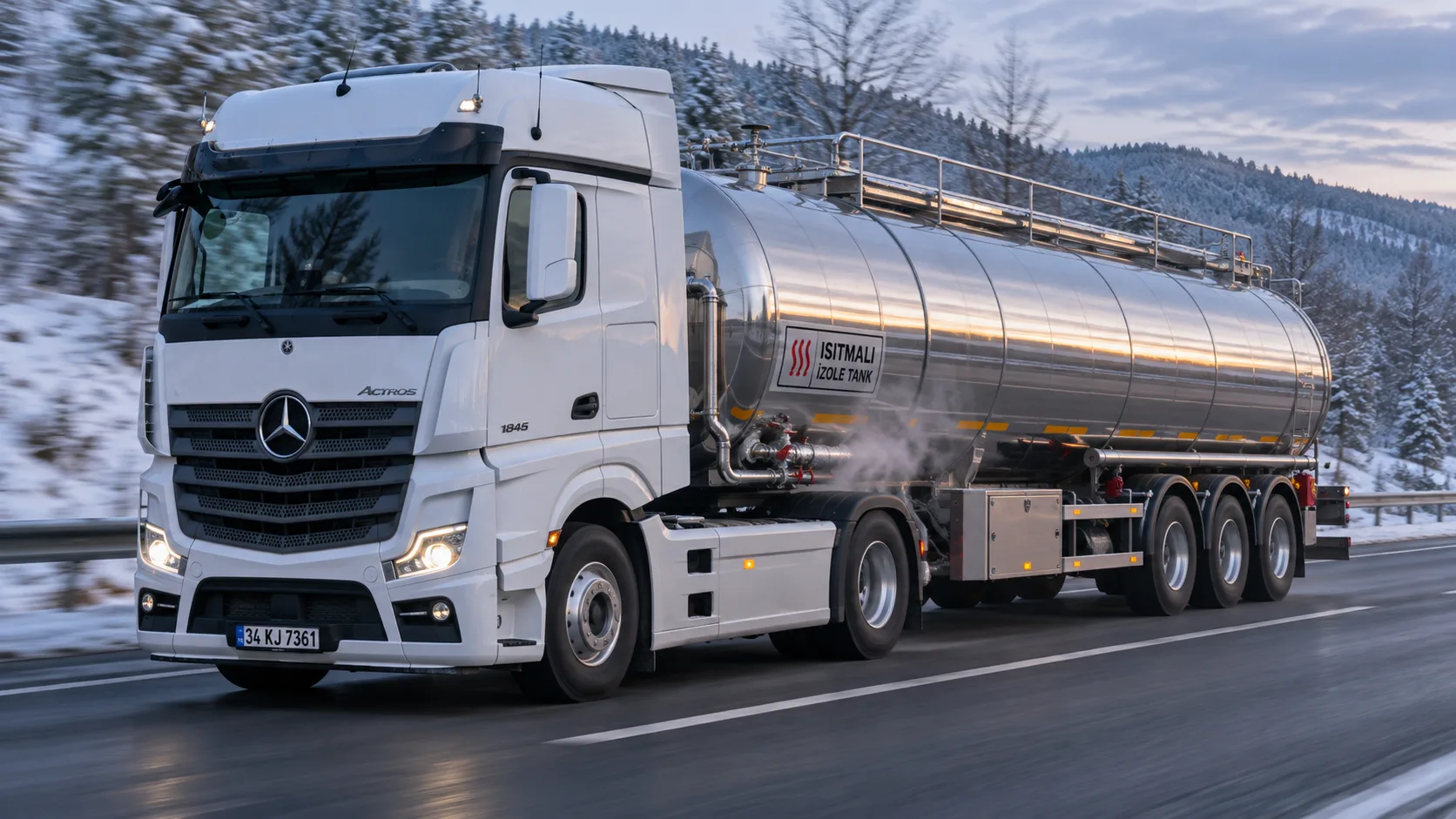
Anyone working in bulk liquid transport knows this job is not just about filling a tank and hitting the road. In the field you face two big problems:
- The product freezing, cooling down or losing its consistency on the way.
- Even the slightest residue or odour from a previous load remaining inside the tank.
Imagine liquid chocolate, olive oil or glucose arriving at your plant, but you are not sure whether that tank carried chemicals before. No matter how well it has been washed, nobody wants to take that risk and put the factory's production in danger.
Or the opposite: a chemical raw material arrives in the middle of winter frozen solid. You open the valve and not a single drop comes out. Your team spends hours connecting steam lines to thaw the product. Time is lost and waiting costs pile up.
At TET Global we keep a tight grip on the process from the very start so you never face these problems on site. We have fully separated the system both in our own fleet and at our wash facility on the Dilmak side.
1. Food Is Food, Chemicals Are Chemicals: Our Tanks Never Mix
You sometimes see this mistake in the industry: the same tank carries a solvent one day, gets washed and is sent for fruit concentrate the next. There is absolutely no place for this in the way we work.
Our rule is very clear:
- Our food tanks are dedicated to food only: Apart from products such as glucose, vegetable oil and fruit juice, not a single drop of chemicals ever enters these tanks. See our food transportation page for details.
- Our chemical tanks are completely separate: Industrial chemicals and dangerous goods (ADR) are carried only in chemical tank containers built for this purpose. See hazardous chemical substance transportation.
So when a vehicle pulls up at your plant, you never have to wonder what that tank carried before. The risk of cross-contamination is zero.
2. The Product Does Not Cool Down on the Road: Continuous Heat Control with Webasto
In winter, when temperatures drop below zero or the journey takes several days, some liquids freeze or crystallise quickly. Once a tank freezes, thawing and unloading it at the destination becomes a real ordeal.
To prevent this, we use Webasto heating systems on our tanks.
The Webasto keeps running while the vehicle is moving or the driver is resting. It circulates controlled hot water and steam through the channels around the tank, keeping the product at exactly the required temperature. When the vehicle reaches your plant the product is fluid: unloading starts as soon as you open the valve, with no extra waiting.
3. We Do Not Just Say "We Kept the Temperature": We Report It with a Datalogger
In logistics it is easy to give assurances in words; what really matters is proving them. Quality control teams rightly want to see the record.
Our tanks carry a datalogger (a digital temperature recorder). Throughout the journey it records the product temperature minute by minute.
When the load reaches your plant, the report you receive clearly shows:
- What temperature was the product at the moment of loading?
- Was there any drop in temperature on the way?
- What was the exact temperature at delivery?
You can see on a clear graph that the temperature chain was never broken and accept the delivery with peace of mind.
4. Washing Is Separate Too at Dilmak: They Are Never Washed in the Same Place
Transporting in separate tanks is only half the job; the really critical point is how those tanks are washed. At TET Global our tanks are washed at Dilmak Tanker facilities (see tank container cleaning). There too, food and chemicals are strictly kept apart:
| Service Detail | Food Tank Washing (Dilmak) | Chemical Tank Washing (Dilmak) |
|---|---|---|
| Wash Bay | Sterile, isolated line dedicated to food only | Chemical wash line with dedicated ventilation and filtration |
| Cleaning Agents | Food-safe, odourless hygiene agents that leave no residue | Neutralising solvents chosen for the previous chemical cargo (MSDS/SDS) |
| Steam and Drying | High-temperature steam + drying with micro-filtered hot air | High-pressure hot water, solvent steam and technical drying |
| Cleaning Document | Cleaning report in line with food hygiene standards | Internationally recognised EFTCO / ECD document |
In short, a chemical tank never enters the food wash line, and a food tank is never washed where chemicals are cleaned. Every tank goes through its own dedicated procedure.
In Summary
When you ship liquid cargo, you should not have to worry. With TET Global's Webasto and datalogger-equipped tanks and Dilmak's dedicated wash stations, your product does not freeze on the road and is delivered clean, with zero risk of mixing.
If you have any questions about the temperature or equipment requirements of the product you want to ship, you can contact our team at any time. Let's work out the best tank and route plan for your needs together; fill in the form to get a quote.